REVIEW · SINGAPORE
Singapore: Singapore Oceanarium Entrance Ticket
Book on GetYourGuide →Operated by GlobalTix Pte Ltd · Bookable on GetYourGuide
Jellyfish that look like stardust. The Singapore Oceanarium turns a rainy-day plan into a real science-and-wildlife stop, starting with a kreisel tank holding 5,000+ moon jellyfish. It is the kind of exhibit that makes you pause, not just walk by.
I also like how the Oceanarium uses hands-on storytelling to connect the dots between marine life and life on land, with life-sized animatronics and fossils and a deep-sea whale-falls exhibit that shows how even a dead whale can power an entire ecosystem. One consideration: a visit can feel complete in about 2.5 hours, so if you’re expecting a full-day attraction with tons of spillover, you’ll likely want to plan a nearby activity too.
In This Review
- Key highlights you should care about
- Where the Oceanarium Is at Resorts World Sentosa
- Start With the Kreisel Tank of 5,000+ Moon Jellyfish
- The Interactive Mangrove Habitat and Touch-Friendly Displays
- Animatronics and Fossils That Explain Marine Evolution to Land
- The Deep-Sea Whale Falls Exhibit That Supports Entire Ecosystems
- The 36m-Wide Reef Panel With Manta Rays and Zebra Sharks
- How Long to Plan: A Typical 2.5-Hour Circuit (Then Slow Down)
- Price and Value: What $43 Gets You in Singapore
- Sustainability and Conservation Backed by Solar Power
- Who This Ticket Fits Best
- Should You Book the Singapore Oceanarium Ticket?
- FAQ
- Where do I redeem my Singapore Oceanarium ticket?
- What is included in the ticket?
- How long is the ticket valid?
- How much does the admission cost?
- Is the Singapore Oceanarium wheelchair accessible?
- Is the ticket refundable?
- When is the Oceanarium closed to the public?
- Is the ticket valid for exclusive events?
- Is the ticket valid only during park hours?
- What should I do when I visit?
Key highlights you should care about
- 5,000+ moon jellyfish in a kreisel tank: a major global wow-factor, especially if you like uninterrupted viewing time.
- Touch-friendly mangrove habitat: you get a more grounded sense of how coastal life survives.
- Marine evolution via animatronics and fossils: not just displays, but a storyline about how bodies and habitats change.
- Deep-sea whale falls: a powerful concept that turns “carcass” into “ecosystem engine.”
- A 36m-wide reef scene: big-panel viewing of reef manta rays and zebra sharks.
Where the Oceanarium Is at Resorts World Sentosa
The Singapore Oceanarium sits inside Resorts World Sentosa, which matters more than you’d think. It means your aquarium visit is easy to combine with other Sentosa-area plans, especially on the kind of day Singapore is known for—warm, humid, and sometimes rainy.
For your timing, the ticket is good for a 1-day visit during regular park hours. You’ll want to redeem it at the Oceanarium directly, then step into a venue designed for self-paced exploring rather than a guided tour with a fixed script.
Start With the Kreisel Tank of 5,000+ Moon Jellyfish
If you only do one thing first, I’d do the jellyfish tank right away. The Oceanarium’s headline feature is a world-class kreisel tank with 5,000+ moon jellyfish, and it has that hypnotic “watching a living snow globe” effect.
Here’s why this exhibit works: the tank design keeps the animals in a constant, natural flow. That makes it easier to see movement and behavior instead of just catching a few seconds between gaps of people.
Also, jellyfish are great for first-time aquarium logic. You don’t need to be an expert to enjoy it, because the spectacle is clear from any angle. The only real advice is practical: give yourself time at the viewing spots. Don’t rush it.
The Interactive Mangrove Habitat and Touch-Friendly Displays
After the big spectacle, the Oceanarium shifts toward “how these ecosystems work.” The interactive mangrove habitat includes touch-friendly biodiversity displays, which help you move from seeing animals to understanding relationships—what lives there, why it matters, and how the coastal zone functions.
Mangroves are one of those places that can feel abstract in textbooks. Here, you’re nudged toward the real idea: coastal habitats are not just scenery. They’re living systems with roles, feeding, shelter, and survival built into the environment.
One tip that improves your experience: pace your stop. Touch-based exhibits are best when you slow down long enough to actually read the prompts and observe nearby life. If you just shuffle through, you’ll miss the point of why this area exists.
Animatronics and Fossils That Explain Marine Evolution to Land
Next, the Oceanarium gets more “story museum,” using life-sized animatronics and fossils to show marine evolution toward land. This is a smart choice for a venue like this, because it turns aquarium viewing into a broader question: how did life make the shift, and what changes mattered?
I like this approach because it gives context to what you’re seeing elsewhere. When you understand that evolution is a chain of adaptations—not a single magic moment—the exhibits start linking together in your head.
This section also helps families and science-curious adults in different ways. For kids, it’s visual and clear. For adults, it’s a reminder that the ocean connects to everything, not just to fish.
The Deep-Sea Whale Falls Exhibit That Supports Entire Ecosystems
Then comes one of the most intriguing concepts in the Oceanarium: whale falls. The deep-sea exhibit shows how whale carcasses can sustain ecosystems, not just for a moment, but as a foundation that supports entire food webs.
It’s a brutal subject in plain language. But it’s also one of the most important ecological lessons you can learn in a single stop: the ocean has recycling built into its deep processes.
If you’re the type who likes exhibits that change how you think, don’t skim this one. Take a minute. Let the idea settle, and you’ll probably leave the Oceanarium carrying it into your conversations later.
The 36m-Wide Reef Panel With Manta Rays and Zebra Sharks
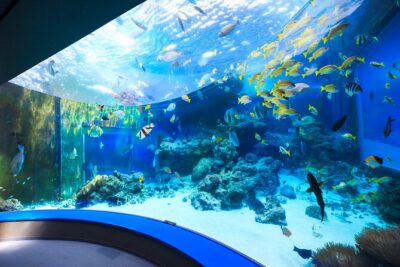
The Oceanarium’s scale shows again in its 36m-wide panel, where you can watch reef manta rays and zebra sharks in a large-format viewing scene. This is the part that often feels like a “movie screen,” but in real life.
Big-panel habitats can be hit-or-miss in some attractions, because crowding ruins your view. Here, the advice is simple: don’t fight the flow. Plan to pause at a viewing point long enough to catch the animals’ pacing patterns.
Also, zebra sharks and manta rays have different “body language.” If you spend a little time here, you can start noticing how they move through water—what looks effortless is actually behavior shaped by environment.
How Long to Plan: A Typical 2.5-Hour Circuit (Then Slow Down)
From a practical standpoint, many people seem to land around 2 to 2.5 hours walking the exhibits at an unhurried pace. That lines up with the Oceanarium’s layout: big anchor displays, then smaller story zones, then the signature reef viewing.
So think of it like this: you’re not signing up for a half-day maze. It’s more like a focused museum visit where you choose how much time to give each highlight.
One small, smart move: after you’ve seen the big tank, grab a snack near it and then take a seat to watch for a while. Sitting down while animals move is a cheat code. You’ll see more, get less tired, and still feel like you used your time well.
Price and Value: What $43 Gets You in Singapore
The ticket price is $43 per person, and that can sound steep until you compare what’s included: admission to a major, multi-exhibit ocean institute at Resorts World Sentosa.
What makes it feel like value is the breadth. You’re paying for more than a single tank. You’re getting multiple types of exhibits: kreisel viewing for jellyfish, interactive mangrove biodiversity, evolutionary storytelling with animatronics and fossils, deep-sea whale falls, and a massive reef panel with manta rays and zebra sharks.
Also, it is a 1-day ticket during regular park hours. That matters for planning. You can fit it into a Singapore itinerary without worrying that you’ll “miss the slot,” as long as you time your visit during open hours and check availability for starting times.
If you’re trying to decide whether it’s worth it for you specifically, I’d base it on one question: do you like exhibits that explain systems, not just animals? If yes, the Oceanarium’s concept will likely justify the price.
Sustainability and Conservation Backed by Solar Power
One thing I appreciate is that the Oceanarium frames itself as more than entertainment. The venue has a Research and Learning Centre built around conservation, research, and community engagement, and it is certified Green Mark Platinum Zero Energy and powered fully by solar power.
That doesn’t mean you’ll suddenly see scientists working in the tunnels. But it does mean the institution is designed with sustainability in mind, and it connects the education you get inside to the work happening behind the scenes.
The Oceanarium is also accredited and connected to major zoo and aquarium networks, including accreditation by AZA and memberships with WAZA and SEAZA. In plain terms: it’s not a random attraction built from scratch. It’s part of a wider conservation-and-care ecosystem.
Who This Ticket Fits Best
This is a good fit if you want an aquarium that treats marine life like science plus story, not just decoration. The mix of moon jellyfish spectacle, interactive mangrove elements, and the deeper whale-falls concept works well for adults who care about how nature connects.
It’s also strong for families because the layout gives multiple entry points. Some sections are pure visuals. Others give you interactive learning moments. And the evolution-from-sea-to-land elements are the kind of “aha” content that sticks.
If you’re short on time and you want to hit a high-impact attraction, this one can do the job in a single day. Just don’t expect it to magically stretch into an all-day activity without planning something else nearby.
Should You Book the Singapore Oceanarium Ticket?
I’d book it if you want a Singapore stop that feels like both a fun show and a serious education. The highlights are specific and impressive—especially the kreisel tank and the 36m-wide reef panel—and the storytelling themes help the visit feel connected rather than random.
I would think twice if you’re the type who needs constant novelty every few minutes. A lot of the experience is spent watching. That’s great for animal lovers, but if you prefer action-heavy entertainment, you may want to pair your visit with another Sentosa plan so the day stays satisfying.
If you’re planning around dates, note the Oceanarium will be closed to the public on 13 June 2026, and your ticket is only valid during regular park hours (not for exclusive events). Check those details early so you don’t build your schedule around a date that won’t work.
FAQ
Where do I redeem my Singapore Oceanarium ticket?
Please proceed directly to the Singapore Oceanarium for redemption.
What is included in the ticket?
The ticket includes Singapore Oceanarium admission.
How long is the ticket valid?
The ticket is valid for 1 day. Check availability to see starting times.
How much does the admission cost?
The price is listed as $43 per person.
Is the Singapore Oceanarium wheelchair accessible?
Yes, it is wheelchair accessible.
Is the ticket refundable?
No. This activity is non-refundable.
When is the Oceanarium closed to the public?
The Oceanarium will be closed to the public on 13 June 2026.
Is the ticket valid for exclusive events?
No. The ticket is not valid for Exclusive Events.
Is the ticket valid only during park hours?
Yes. It is valid only during regular park hours, and hours may change without notice.
What should I do when I visit?
Follow all posted guidelines. Not following them may cause injury or result in being asked to leave.